
In 2026, many employees are facing burnout, pressure and low trust in leadership. Yet small acts of kindness still have the power to change how people experience work.
Research has often shown that giving and receiving kindness at work can improve happiness, connection and trust across an organization.
These real office moments show that compassion is not a soft extra. It is one of the strongest foundations of a healthier workplace.
A Manager Who Learned From Grief
One employee returned to work the day after his wife died because he needed the insurance. His boss coldly told him to “be a man” and said grief was a choice.
Six months later, the boss lost his own wife. When he returned after three months away, he quietly apologized. He admitted that his late wife would have been ashamed of what he had said.
The apology did not erase the hurt, but it changed him. He became a more human manager because he finally understood what he had once dismissed.
Fixing Pay Inequality Without Drama
Another employee discovered that a male colleague doing the same job had earned much more since day one. Her manager dismissed it as a negotiation issue.
But the head of finance saw the problem differently. She reviewed the salary band, confirmed the employee was underpaid and corrected it with 18 months of back pay.
She did not seek praise. She simply fixed what was wrong.
Respecting Health Without Interrogation
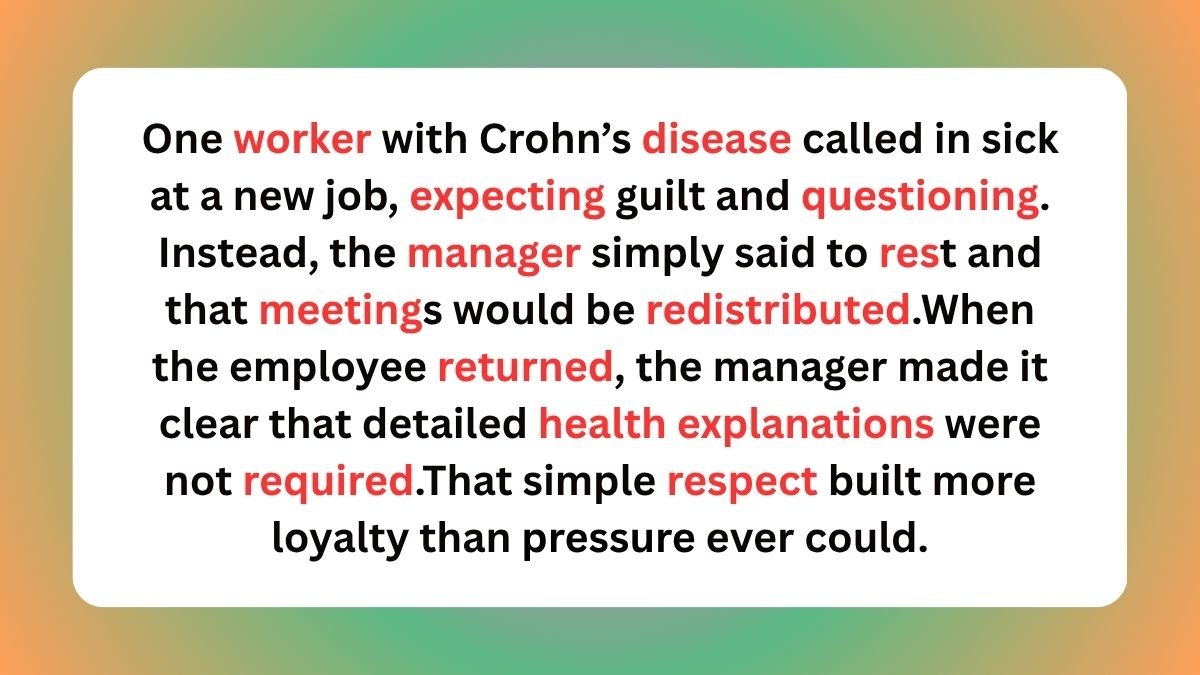
One worker with Crohn’s disease called in sick at a new job, expecting guilt and questioning. Instead, the manager simply said to rest and that meetings would be redistributed.
When the employee returned, the manager made it clear that detailed health explanations were not required.
That simple respect built more loyalty than pressure ever could.
Taking Responsibility Fast
A worker was wrongly blamed for a data error in front of others. The mistake had actually come from another team.
The colleague responsible did not wait. She immediately told the director the truth and apologized. Her honesty protected someone else from unfair blame and set a standard for integrity.
A Reference That Changed A Career
One job applicant was stuck because a current employer would not provide references. She reached out to a woman she had met only once at an industry event.
That woman remembered her presentation and agreed to be a reference. Her support helped the applicant get the job. Sometimes one person’s belief can open a door that would otherwise stay closed.
Fairness Found In A Spreadsheet
Another employee had been overlooked for promotion twice.
A senior HR leader later noticed a pattern showing that women in the department were being rated lower on leadership potential despite strong performance.
The audit led to promotion reviews, and three women were promoted in the next cycle. The leader did not ignore the pattern. She acted on it.
Quiet Help During Financial Stress
One employee was quietly struggling with money and eating crackers at work while pretending not to be hungry. A teammate noticed and began bringing extra food.
She did not embarrass the person or ask painful questions. She simply made sure they ate. That kind of kindness protects dignity.
Honoring Someone After 11 Years
When a longtime employee was laid off after 11 years, the company planned only a basic farewell. A junior colleague decided that was not enough.
She gathered personal messages, contacted former coworkers and created a proper send-off. Her reason was simple: someone should.
Defending An Unfair Review
One employee received a vague and damaging performance review from a manager who seemed determined to create a paper trail. A senior manager from another department knew the review was unfair.
She challenged it with HR, and the review was amended after the claims could not be supported. Speaking up mattered.
A Message After A Panic Attack
During a company-wide Zoom call, one employee had a visible panic attack and logged off in shame. A senior director messaged afterward, saying he had panic attacks too and that nobody was talking about it.
That short message helped the employee feel less alone.
Conclusion
These office moments prove that kindness still matters in 2026. A fair decision, a quiet apology, a shared meal, a supportive message or an honest correction can change someone’s entire experience at work.
Happier workplaces are not built only by policies. They are built by people who notice, care and act with compassion.