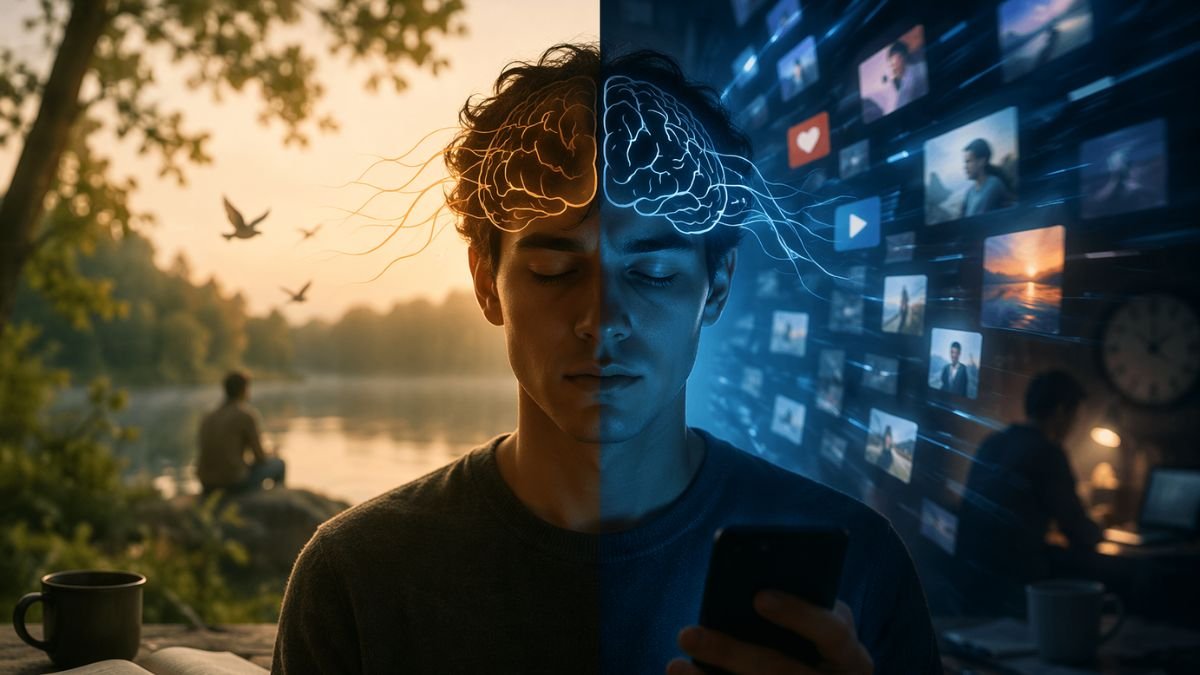

It feels simple. You open your phone, scroll, click, respond, and move on. Everything seems under control, as if you are directing the experience. But beneath this surface, something more complex is happening—something that is not immediately visible.
Human interaction with technology is no longer just about tools performing tasks. It has evolved into a continuous loop where people and systems influence each other. Research in human–computer interaction shows that technology is designed not only to respond to users but also to shape how users behave, think, and make decisions over time.
This creates a subtle shift. The user is no longer just interacting with technology—the interaction itself becomes part of how the user thinks.
When Thinking Starts to Mirror the System
Over time, repeated interaction with digital systems begins to influence cognitive patterns. Information is processed faster, attention shifts more frequently, and responses become shorter and more immediate.
This adaptation is not accidental. Human–computer interaction research highlights how systems are built around human cognitive processes—attention, memory, and perception—while also gradually reshaping them.
As a result, thinking begins to align with the structure of the technology itself. The mind adapts to the rhythm of notifications, updates, and rapid input-output cycles. What once required sustained focus is now broken into fragments.
The Subtle Redefinition of Attention
One of the most significant changes happens in attention. Instead of remaining on a single task, the mind becomes accustomed to switching constantly between stimuli.
This shift creates a new kind of focus—one that is flexible but also more easily interrupted. It allows quick responses and multitasking, but it can also reduce depth in processing.
This does not mean attention is lost. It means attention is being restructured. The brain is adapting to an environment where information is continuous, immediate, and constantly changing.
Interaction That Feels Personal—Even When It Isn’t
Another important aspect of this transformation is how technology begins to feel socially meaningful. Systems respond, provide feedback, and create the impression of interaction that resembles human communication.
Human–computer interaction studies have long shown that people apply social behaviors to machines, responding to them as if they were engaging with another person.
This creates an experience where interaction with technology is not just functional—it becomes relational. Responses feel like acknowledgment, feedback feels like validation, and engagement begins to carry emotional weight.
The Gradual Shift in Behavior and Habit
As these interactions repeat, they form patterns. Checking devices becomes automatic. Responding quickly becomes expected. Seeking information or feedback becomes a default reaction.
These behaviors are not random. They are shaped by environments designed to encourage engagement. Over time, they become habits that operate without conscious decision.
This is where the influence of technology becomes most powerful—not in individual moments, but in repeated patterns that slowly redefine behavior.
The Gap Between Awareness and Influence
One of the most striking aspects of this process is how little of it is consciously noticed. People are aware of using technology, but they are not always aware of how it is shaping their thinking.
This gap allows changes to accumulate gradually. Because they are small and continuous, they do not trigger immediate reflection. Instead, they become part of the background of everyday life.
Only over time does the shift become visible—when attention feels different, when thinking feels faster but less deep, or when interaction patterns feel automatic rather than intentional.
A New Kind of Human Experience
The research suggests that human experience itself is evolving. Interaction is no longer limited to people and physical environments. It now includes continuous engagement with digital systems that actively shape perception and behavior.
This does not mean something is lost—it means something is changing. The way people process information, respond to stimuli, and experience connection is being redefined.
Human–computer interaction is not just about improving usability. It is about understanding how technology becomes part of the human experience itself.
The Question That Changes Perspective
The most important insight is not that technology influences behavior—it clearly does. The deeper question is how much of that influence is being actively chosen and how much is happening automatically.
Because once that question is asked, everyday actions begin to look different. Scrolling is no longer just scrolling. Interaction is no longer just interaction.
It becomes part of a larger system—one where the line between user and environment is no longer as clear as it once was.
And in that realization lies something both powerful and unsettling: the possibility that while we believe we are shaping technology, it is quietly shaping us in return.
The study has been officially published in Taylor & Francis Online in Aphasiology